 











 Picnic
spot Picnic
spot
 Historic site Historic site
 Educational Educational
 Fun activity Fun activity
 Toilet facilities Toilet facilities
 Gravel road Gravel road
 Rainy day route Rainy day route
 Area Map Area Map
Caution
- Malaria
The Lowveld and the
Kruger National Park falls within a malaria
area. Please consult your pharmacist or doctor
at least a week before your visit. |
Webmaster's
Note:
Although the crime rate in the area is low, petty
theft does occur from time to time. You are
advised to lock your parked vehicles. |
|
|

|
|
| Short,
day-trip drives from Sabie
|
|
Big-5
Routes
The two separate Big-5 Routes are both
favourite routes, especially when inclement weather
boycott some of the other day trips from Sabie.
The first option covers a
wildlife rehabilitation centre, a Cheetah
breeding centre, a silk farm and a reptile park.
Set a full day aside for a
visit to the Kruger National Park.
|
Option
1
Option
2
|
|
Option
1
Webmaster's Note:
The shortest
routes from Sabie to the Cheetah Breeding
Centre and the Moholoholo Rehabilitation
Centre is via Graskop or Hazyview and
Bushbuck Ridge. These routes are not
the recommended routes. The
Bushbuck Ridge area (a former homeland area
of South Africa) is not scenic and it is
potentially dangerous to stop here due to
the possibility of being robbed or hijacked.
Suggest you travel the longer
route via Pilgrim's Rest and Ohrigstad, or
via Graskop and Burke's Luck
Potholes. Resist the temptation to
stop at all the viewpoints on the way
there and depart early enough to be on
time for the first guided tour at 09:30 at
the Moholoholo Wildlife Rehabilitation
Centre (allow about two hours for the
150km trip via Pilgrim's Rest).
|
 Moholoholo Wildlife Rehabilitation Centre
From Sabie travel on the R532 and R533 via Pilgrim's
Rest to the R36 junction. Follow the R36 via
Ohrigstad and the Strydom tunnel and then follow the
R527 and R531 towards Klaserie. The Moholoholo
Wildlife Rehabilitation Centre is 15km along the R531.
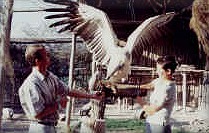 The Centre has
become a haven for the rehabilitation and care of sick
and injured animals and birds. Wildlife is
brought to the Centre from all corners of South
Africa, and once healthy enough are re-introduced into
their natural environment. There are however some
species which have been rehabilitated but due to the
long term effects of their injuries, still stand no
chance of survival in the wild. These animals and
birds are kept on the premises and used in educational
tours. The Centre has
become a haven for the rehabilitation and care of sick
and injured animals and birds. Wildlife is
brought to the Centre from all corners of South
Africa, and once healthy enough are re-introduced into
their natural environment. There are however some
species which have been rehabilitated but due to the
long term effects of their injuries, still stand no
chance of survival in the wild. These animals and
birds are kept on the premises and used in educational
tours.
The Centre is open to the public and offer guided
tours that last approximately two hours. There is also
a tea garden at the Centre. 
Times: 09:30 and 15:00 (Mon - Sat)
15:00 (Sundays on Long Weekends and School Holidays)
Fees: R110/person (older than 13 years)
R90/pensioner
R55/child (7-12 years)
Hoedspruit Endangered Species Centre
From the Moholoholo Centre follow the R531 towards
Klaserie and turn off left on the R40. The
turnoff to the Hoedspruit Research and Breeding Center
for Endangered Species is 3 km along the R40
towards Hoedspruit.
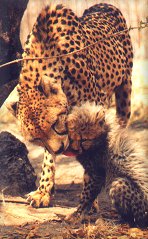 The Centre conducts unique research on endangered
species such as cheetah, wild dogs and lion. Tours of
the Centre starts with an informative video
presentation where interesting background information
on the animals, the research being conducted and the
progress of the project is presented.
The Centre conducts unique research on endangered
species such as cheetah, wild dogs and lion. Tours of
the Centre starts with an informative video
presentation where interesting background information
on the animals, the research being conducted and the
progress of the project is presented.
An experienced guide will then accompany you on a
tour of the Centre where the highlights will include
the viewing of more than 60 hand-reared cheetahs, the
vulture restaurant, wild dogs and the rare Barbary
lion. A walk with Jabulani the elephant is also an
optional extra. After the tour you can enjoy a
light meal and refreshments in their tea garden or
shop in the curio shop.
Times: 09:00 - 15:00 (Tours on the hour)
Fees:
Entrance: R130/adult, R60/child (5-11
years)
Vulture/Wild Dog Feeding: R100/person (in
addition to entrance fees)
Platinum Tour: R2,000/vehicle (in
addition to entrance fees)
Khamai Reptile Centre
From the Silk Farm continue (north-west) with the
R531. At the T-junction with the R527, turn right
towards Hoedspruit. The Reptile Centre is 2.3km
further on your left hand side.
| In
1984 the Swadini Reptile Park was founded
and developed by Donald Strydom a pioneer in
the care and rehabilitation of "problem
reptiles" in the Hoedspruit region. Now
known as the Khamai Reptile Centre, it is a
renowned South African landmark and Strydom
has had his work featured on international
television networks such as The National
Geographic Channel and The Discovery
Channel.
|
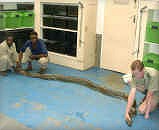
A
gravid African Rock Python is measured
before being released back into the wild.
|
The Khamai Reptile Centre has been
collecting data from animals caught in the
wild for the past 16 years and has been
inspired to initiate a number of research
projects through HERP (Help Endangered
Reptile Project) dedicated to the
conservation of reptiles through education
and research.
Times: 09:00 - 17:00
Fees:
Day Visitors: R50/adult, R25/child (4-14)
Interactive Tour: R75/person (min 6 people)
Photographic Tour: R750/group (Max 6)
|

Largest Baboon Spider in the World (7cm
body length)
|
Boabab Tree
From the Reptile Park continue west for 17km on
the R527 in the direction of Tzaneen and turn
right on the R36. The Boabab tree is a short
distance from the turnoff.
The Boabab tree (Adansonia digitata), and
in particular this tree, is one of the Big-5 in
the plant kingdom. Boabab trees grow to a
circumference of 28m and live to be thousands of
years old. The fruit pods contain large
quantiies of tartaric acid and African folklore
tell us that God, in his anger with the stupidity
of mankind, planted the Boabab tree upside down.
Tufa Waterfall
From the Boabab tree drive back to the R36 and turn
right towards Ohrigstad. On exiting the
Strydom Tunnel, stop at the parking lot. The
Tufa Waterfall can be seen across the valley.
A tufa waterfall is
formed when water running over dolomite rock
absorbs calcium. Mosses which grow on the
rocks in the stream extract carbon dioxide during
photosynthesis which precipitates the calcium from
the water to deposit it as layers of tufa on the
surface of the waterfall - a process that takes
millions of years. The waterfall continue to
flow underneath this rock-hard outer shell.
This is one of but a few active tufa waterfalls in
the world.
Webmaster's Note:
This
conclude Option 1 of the Big-5
Route. Follow the R36 towards
Ohrigstad and return to Sabie via
Lydenburg and the Long Tom Pass (R37),
or via Robber's Pass and Pilgrim's Rest
(R533). |
Option
2
Kruger National Park
The world renown Kruger National Park's (KNP)
closest entrance gate to Sabie (the Phabeni Gate)
is 60km from Sabie. Travel to Hazyview on the
R536 and turn right at the T-junction (R40
road). Turn left after 2km on the R536 to the
Kruger Gate. The turnoff to the Phabeni Gate is a
further 10km from Hazyview.
The KNP measures 400km from north to south, and
is approximately 70km at its widest point,
covering a total surface area of almost 2 million
hectares. The KNP is home to 147 mammal, 114
reptile, 33 amphibian, 50 fish, 500 bird and 300
tree species. The KNP is being incorporated
into the Gaza-Kruger-Gonarezhou (GKG)
Transfrontier Park. The GKG Transfrontier
Park covers an area of more than 35 million square
kilometres and will be one of the largest wildlife
conservation area in the world.
General Rules:
No pets or firearms are allowed. (If you do carry
a firearm, declare it at the entry gate.) No
alchoholic beverages may be taken into the Park
(gate guards may search your vehicle and cooler
boxes). Stay in your vehicle at all times, except
inside the camps, at picnic spots or at designated
viewing points. Animals inside the KNP are
wild and, therefore, unpredictable and potentially
dangerous - no matter how docile they may
appear. Do not attempt to reach out, pet or
feed the animals.
Speed Limits:
The speed limit on all tarred roads is 50 km/h and
on gravel roads 40 km/h. Suggest you travel
at no more than 30 km/h to spot the maximum number
of wildlife.
Day Visitors:
During peak season (long weekends and school
holidays) the KNP usually limit the number of day
visitors on a first-come-first-served basis.
Ensure that you are at the gates at least 30 to 40
minutes before they open.
Gate Times:
(Times are for both Entry and Camp gates, unless
indicated otherwise)
| Month |
Nov-
Jan |
Feb |
Mar |
Apr |
May-
Jul |
Aug |
Sep |
Oct |
Gates
Open |
04:30
(camp)
05:30
(entry) |
05:30 |
06:00 |
06:00 |
06:00 |
06:00 |
06:00 |
05:30 |
Gates
Close |
18:30 |
18:30 |
18:00 |
18:00 |
17:30 |
18:00 |
18:00 |
18:00 |
Restaurant Times:
| Breakfast |
Lunch |
Dinner |
| 07:00
- 09:00 |
12:00
- 14:00 |
18:00
- 21:00 |
The shops are open
from 08:00 until ½ hour after gate closing time.
Conservation Fees (/person/day):
(Valid until 31 October 2020)
SA Citizens:
R100/adult, R50/child (2-11 years)
SADC Nationals: R200/adult, R100/child (2-11 years)
Other Nationals: R400/adult, R200/child (2-11 years)
Webmaster's Note:
 Most visitors to
the KNP
consider the
sighting of the Big-5 (lion, leopard,
elephant, rhinoceros and buffalo) a
successful visit to the Park. This
is indeed so, but a visit to the Park
can be a rewarding and unforgettable
experience, even if you don't see any
one of the Big-5 species. Look out
for the Little-500 - birds, plants,
insects, reptiles, and smaller mammal
species. Consider how they
interact, depend and rely upon one
another in an intricately balanced
ecosystem. Most visitors to
the KNP
consider the
sighting of the Big-5 (lion, leopard,
elephant, rhinoceros and buffalo) a
successful visit to the Park. This
is indeed so, but a visit to the Park
can be a rewarding and unforgettable
experience, even if you don't see any
one of the Big-5 species. Look out
for the Little-500 - birds, plants,
insects, reptiles, and smaller mammal
species. Consider how they
interact, depend and rely upon one
another in an intricately balanced
ecosystem. |

Back to Day-Trips
|
|